

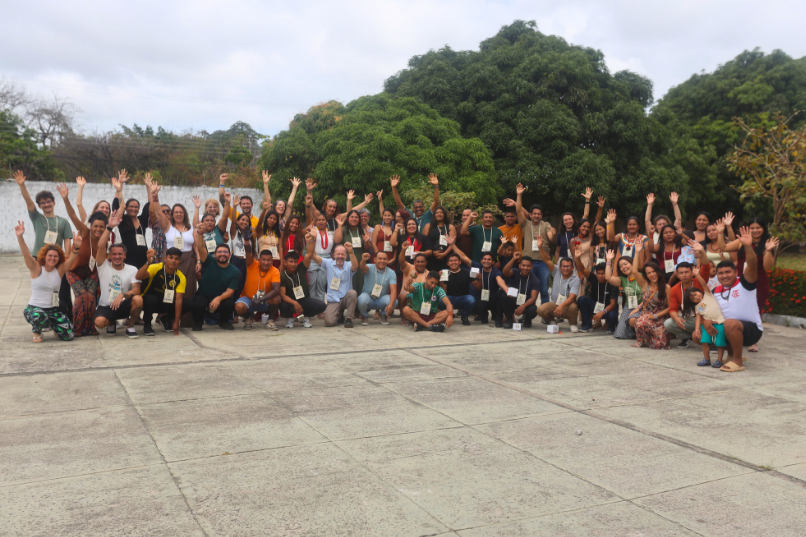
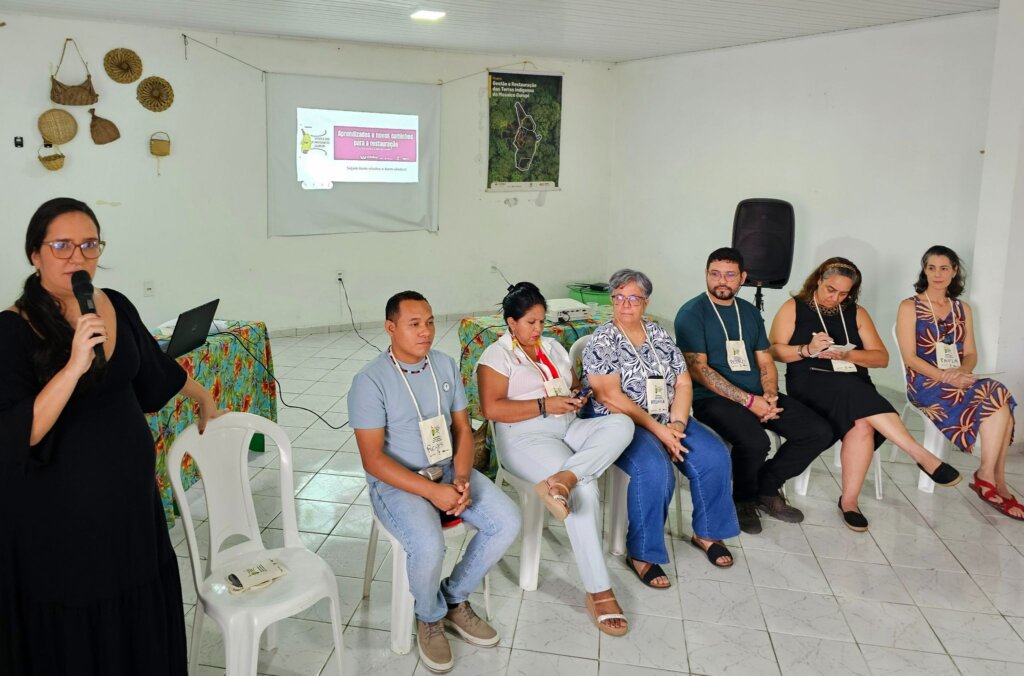
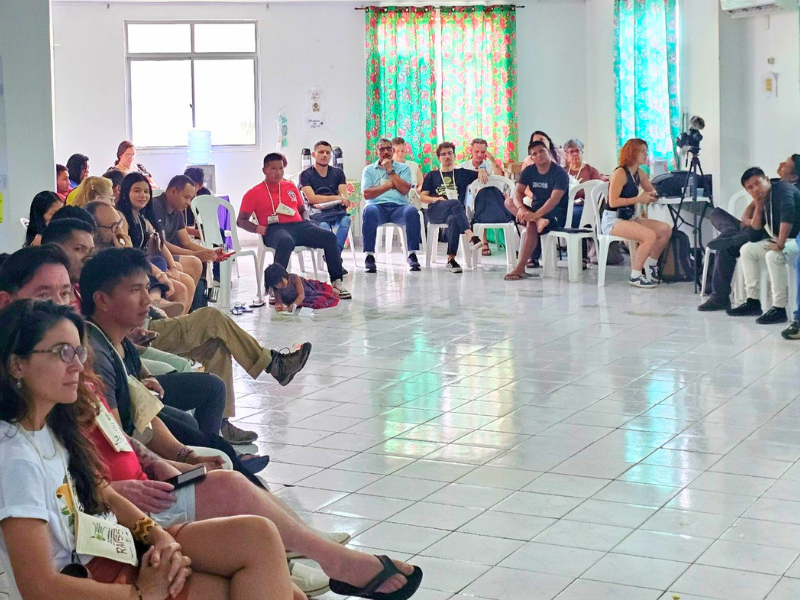
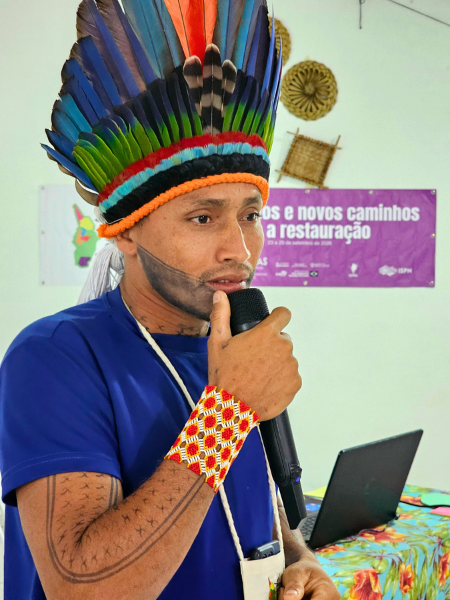
Nine Indigenous organizations from the Gurupi Mosaic met in Paço do Lumiar, a city in the São Luís Metropolitan Region, Maranhão, on September 23, 24, and 25, for the seminar “Lessons Learned and New Paths for Restoration.” The event was organized by ISPN with two objectives: first, to conduct a collective evaluation, after four years of implementation, of the Management and Restoration of Indigenous Lands of the Gurupi Mosaic Project; and second, to launch a new project: the Tupi-Timbira Alliance for the Restoration of the Forests of Eastern Amazonia , developed by the institute also based on the demands of the Indigenous peoples of the Gurupi Mosaic.
“The idea of bringing the two projects together – one that is ending and another that is beginning – in the same seminar, stemmed from the panoramic and strategic vision of the work that ISPN develops in the region. Each project has its own specificities, but both share the common goal of strengthening the Gurupi Mosaic and the initiatives developed by indigenous peoples in their territories, focusing on territorial protection, conservation of life, conservation of biodiversity, and environmental restoration ,” explains João Guilherme Nunes Cruz, coordinator of the Indigenous Peoples Program (PPI) at ISPN.
The Gurupi Mosaic was officially recognized by the Ministry of Environment and Climate Change (MMA) in July of last year, after years of advocacy by the Network of Protected Area Mosaics (Remap), ISPN and other institutions that make up its Advisory Council, and with the leading role of indigenous leaders with government agencies, such as the Chico Mendes Institute for Biodiversity Conservation (ICMBio), the MMA itself, the Ministry of Indigenous Peoples (MPI) and the National Foundation for Indigenous Peoples (Funai).
The result was that, for the first time, Brazilian environmental policy recognized a mosaic of protected areas composed of a single conservation area with a predominance of Indigenous Lands: the Gurupi Biological Reserve (Rebio Gurupi) corresponds to only 5,9% of the total 46 km². The remaining area, that is, 43,3 km², is composed of six Indigenous Lands: Araribóia, Caru, Rio Pindaré, Alto Turiaçu and Awá; in Maranhão; plus the Alto Rio Guamá Land, in Pará.
One of the objectives of the Management and Restoration of Indigenous Lands in the Gurupi Mosaic Project was to consolidate a network for the management and restoration of these territories across these six Indigenous Lands.
“It was a very strategic project to expand this network of connection and collaboration between organizations operating in the territories and between these organizations and ISPN itself. For us, it is very important to value the results of the projects that were developed in partnership with the Copaíbas Program ,” says Paula Ceotto, Project Manager at the Brazilian Biodiversity Fund (Funbio), who participated in the Seminar, both to celebrate the results and to learn directly from the indigenous organizations about their experience with the work developed.
Funbio, through the Copaíbas Program, funded the Management and Restoration of Indigenous Lands in the Gurupi Mosaic Project.
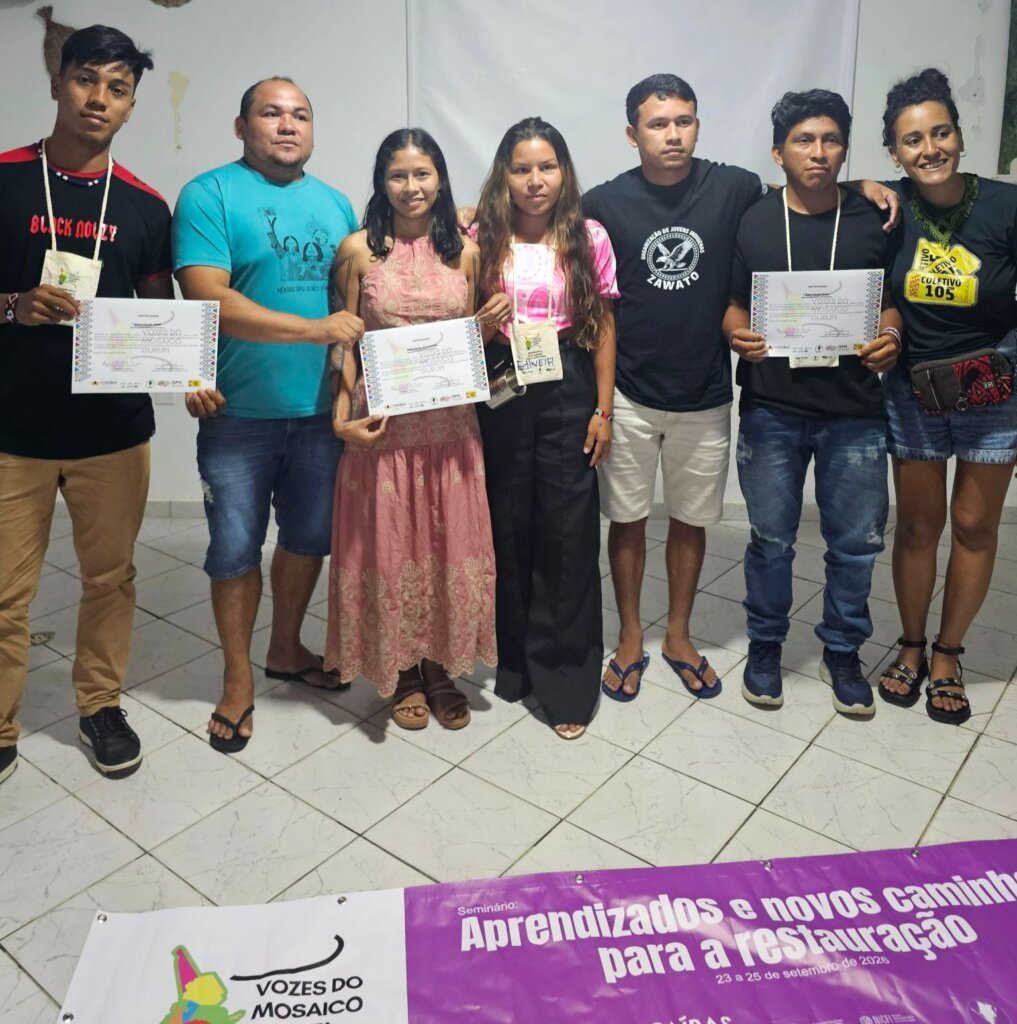
“The initiative was very important because it brought the possibility of autonomy to indigenous organizations and associations in terms of financial execution and, of course, when we talk about territorial protection, we also talk about the restoration of Indigenous Lands, and that is very positive for us. So it was a project that came to strengthen our organization at the state level and that helped us to be more present throughout the territory ,” adds the coordinator of the partner institution of the initiative, the Coordination of Organizations and Articulations of Indigenous Peoples of Maranhão (Coapima), Régis Guajajara, who is from the Araribóia Indigenous Land, where one of the actions of the Management and Restoration Project was to support the revision of the Territorial and Environmental Management Plan (PGTA).
Through this project, ISPN was also able to directly support the participation of representatives from indigenous territories in the political advocacy process for the formal recognition of the Gurupi Mosaic and its Advisory Council.
“After years of coordination with government agencies, institutions, research entities, social movements, and indigenous peoples, there is now a legal framework that recognizes and provides guidelines for the actions of the Gurupi Mosaic Advisory Council ,” comments Thayane Tavares, coordinator of the Management and Restoration Project and socio-environmental analyst at ISPN.
Pressures
Despite official recognition by the Brazilian State, the Gurupi Mosaic remains one of the ten most critical areas in terms of deforestation in the Brazilian Amazon and suffers from threats to biodiversity, environmental services, and the rights of indigenous peoples. The Gurupi Biological Reserve is on the list of the 50 most deforested conservation units in 2025 – with 101 hectares of deforestation that year – as detailed in the Annual Report on Deforestation in Brazil 2025 – MapBiomas (RAD 2025). Among the Indigenous Lands that make up the Mosaic, only Alto Turiaçu is on the list of the 50 most deforested in RAD 2025, but this does not mean that there are no pressures on the others.
“Our territory is constantly suffering from invasions ,” laments Rafael Tembé, from the Alto Rio Guamá Indigenous Land in Pará, who participated in the Seminar representing the Tembé AITATZUHU Indigenous Association. Through the Management and Restoration of Indigenous Lands of the Gurupi Mosaic Project, various actions and activities for territorial protection have been carried out. In the Alto Rio Guamá Indigenous Land, Rafael Tembé highlights that the strengthening of the Forest Guardians was very important. The group of Forest Guardians is made up of indigenous people who carry out routine expeditions through the territory to monitor the illegal actions of loggers, miners, hunters, farmers, traffickers, and other invaders. When they find any sign of invasion, the Guardians contact government and security agencies, such as Funai, the Brazilian Institute of Environment and Renewable Natural Resources (Ibama), and the National Force.
“We can’t prevent 100% of the invasions, but we prevent 50% to 70%. Our territory was cleared of intruders a few years ago, and today we can already see the impact of the Guardians’ work with the return of animal species that no longer circulated in certain parts of our territory. So we see the Guardians’ actions in a very positive light ,” says Rafael Tembé.
Restoration of 120 hectares in the Deforestation Arc
Another highlight of the event was the launch of the Tupi-Timbira Alliance Project for the Restoration of the Forests of Eastern Amazonia, or the Gurupi Indigenous Mosaic Restoration Project, developed by ISPN and indigenous organizations in response to the deforestation and environmental degradation left as a legacy by the advance, in recent decades, of agricultural frontiers over the indigenous territories of a region known, not by chance, as the "Arc of Deforestation".
The Arc of Deforestation is located on the eastern edge of the Amazon where the Gurupi Mosaic is situated. A significant difference between the Tupi-Timbira Alliance and the Management and Restoration Project is the inclusion of the Kanela Indigenous Land, which extends across two municipalities: Fernando Falcão and Barra do Corda; in addition to the Indigenous Lands that make up the Gurupi Mosaic. The Kanela Land is under strong external pressure. The territory borders the Kanela Memortumré Land, which was the second most deforested Indigenous Land in the country in 2025. According to the RAD 2025, the Kanela Memortumré Land lost 1.025 hectares of native vegetation, or the equivalent of more than 1.400 football fields.
Another factor in the inclusion of the Canela Indigenous Territory in the Tupi-Timbira Alliance is the experience of the Kanela people, who have been working for years with the Indigenous Work Center on a diagnosis for the development of restoration strategies. The Kanela Indigenous Territory also participates in the mobilizations surrounding the creation of the Mirador Mosaic.
While ISPN's previous project combined territorial management with restoration, the focus of the Tupi-Timbira Alliance is restoration. "Our goal is to restore 120 hectares in the Indigenous Lands of the Gurupi Mosaic and the Kanela Land, and also to consolidate a restoration network within the Mosaic ," explains ISPN's socio-environmental analyst, Raíssa Ribeiro.
“The Tupi-Timbira Alliance brings together a series of restoration strategies and methodologies with indigenous leadership and aims, ultimately, to structure an articulated network between the protected areas of the Gurupi Mosaic and the Kanela Indigenous Land focused on restoration, through the planned circulation of forest seeds, strengthening of nurseries, exchanges, projects carried out by indigenous associations, among other actions ,” says the coordinator of the Indigenous Peoples Program at ISPN, João Guilherme Nunes Cruz.
ISPN has been conducting workshops in indigenous territories to understand the communities' needs for restoration. The workshops also discuss what type of restoration is most appropriate for each specific area. “We are trying to understand how they would like to restore: whether it's direct seeding, whether large-scale restoration is needed, or whether it's restoration for territorial protection. So, with this project, we hope to achieve these objectives of restoring 120 hectares and consolidating this restoration network in the Gurupi Mosaic ,” says Raíssa Ribeiro.
Robert Miller, technical coordinator of the Tupi-Timbira Alliance Project and socio-environmental analyst at ISPN, highlights the role of restoration in the management of indigenous territories and the environment.
“Restoration goes hand in hand with territorial protection; it is part of the care that indigenous peoples have for the conservation of biodiversity, for the conservation of territories, and for this pursuit of well-being, of having in restoration the return of resources that have become scarce, especially the issue of animals, fauna, and hunting, which is very important for rituals. Therefore, the restoration of areas that have been degraded in recent decades is a very important component of this management of the territories of the indigenous peoples of the Gurupi Mosaic . ”
The Tupi-Timbira Alliance project is supported by resources from the Amazon Fund and is part of Restaura Amazônia – a program of the National Bank for Economic and Social Development (BNDES) and the federal government, which has Conservation International (CI-Brazil) as a managing partner.