
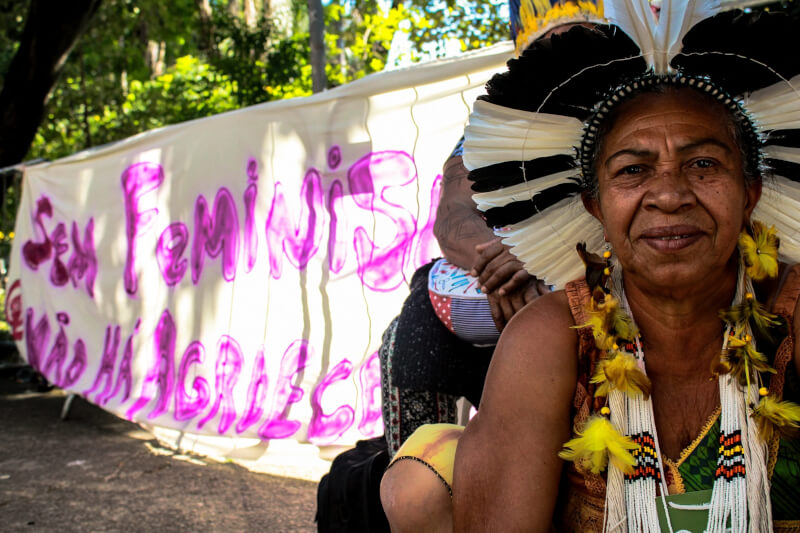
“Prevention is the best way. We have suffered great losses in our village due to cancer. This moment is important so that we can bring more and more information to our relatives in other villages as well,” reinforced Chief Bruno Caragiu Guajajara during the culmination of the Pink October and Blue November campaigns. The event took place on the 05th of this month in the Januária Village, municipality of Bom Jardim (MA), within the scope of the Basic Environmental Plan – Indigenous Component (PBA-CI), through the Health Subprogram, in partnership with Vale S/A. The activity was also organized by the Special Secretariat for Indigenous Health Care and the Ministry of Health (Sesai).
The event's program included lectures, workshops, and screenings of educational videos focused on guidance and awareness of the importance of preventing cervical, breast, and prostate cancer. Preventive exams, vaccinations, and dental care were also provided.
For the young Indigenous woman and nursing student, Taynara Caragiu Guajajara, care is very important, as prevention is still the best medicine. “We, Indigenous women, value the knowledge passed on by the entire health post team, while also using our preventive and curative methods from our Guajajara medicine. It is of utmost importance for us Indigenous women to use Western medicine and Indigenous medicine as allies, thus strengthening preventive practices,” she emphasized.
“The state of presence can be the beginning of prevention and care in indigenous health. It is precisely about being aware of oneself. A person must be connected with their thoughts and their physical body. It is the balance between mind and spirit. And this is reflected in health,” said Solange Sousa, a nurse-midwife and professor at the Federal Institute of Education of Maranhão, during the event.
“When we stop to observe our habits, we also perceive our existence, our reality. We are losing the notion of living in the present moment. In this sense, care and feeling our breath are also fundamental. Many times, we project ourselves into the past or future, which is why we are losing the essence of being human. That is, the importance of looking into someone's eyes, of seeing ourselves in others, of self-care, of perceiving our bodies. When our mouths are silent, our organs speak,” explained Solange Sousa.
PBA-CI – This is an integral part of the environmental licensing process for the Carajás Railway (EFC) – Indigenous Component project, operated by Vale SA and aimed at the Awá and Guajajara peoples of the Caru and Rio Pindaré Indigenous Lands in Maranhão. It is structured around two components (Awá and Guajajara), implemented by ISPN, and organized into five subprograms: Territorial Protection; Cultural Strengthening; Institutional Strengthening; Ethnodevelopment; and Health.