

By Elvis Marques – CPT Communication

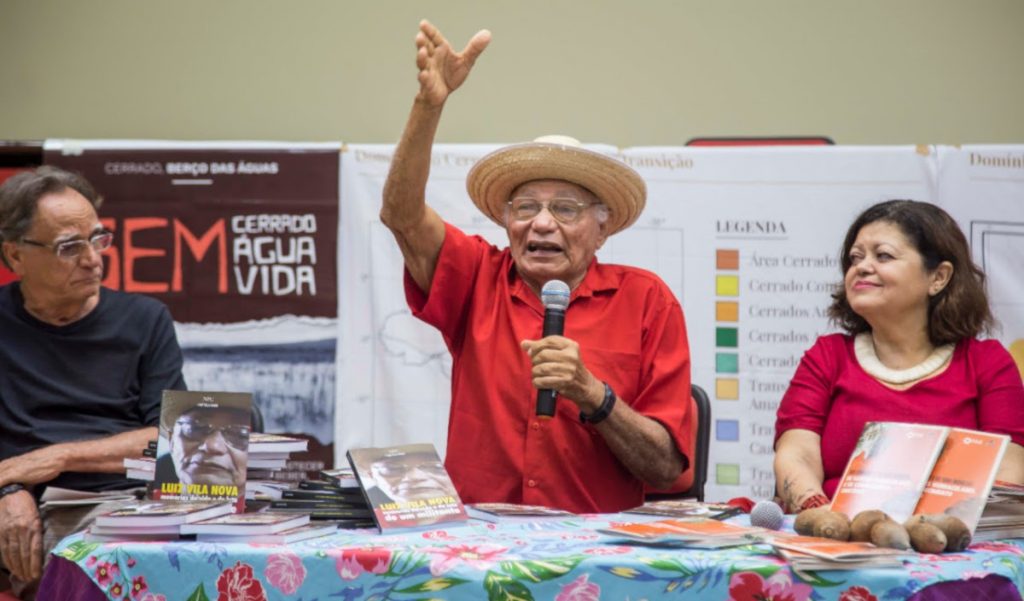
In the capital of Maranhão, three works about the Cerrado biome and the life and activism of Luiz Vila Nova were presented to the public during an activity of the National Campaign in Defense of the Cerrado.
"From the Cerrado and its riches: from vernacular knowledge and scientific understanding" is a book that brings together lessons learned from the struggle to defend the biome and the peoples and communities whose lives are rooted in this land. The publication is authored by Carlos Walter Porto-Gonçalves, professor of the Postgraduate Program in Geography at the Federal Fluminense University (UFF), and organized by the Federation of Organizations for Social and Educational Assistance (FASE) and the Pastoral Land Commission (CPT).
At the same event, Rio de Janeiro journalist Claudia Santiago, from the Piratininga Communication Center (NPC), presented her book about an important figure in the agrarian struggles of Maranhão: “Luiz Vila Nova – a memoir of the life and struggle of a militant.” Wearing a straw hat, glasses, and a red shirt, just like on the book cover, Vila Nova, recounting the beginning of his activism, was incisive: “Today, if I continue in the struggle, it’s because that seed was planted in adolescence, when I was still very young. The most important time to prepare a citizen is in adolescence, not when they are an adult, because by then the citizen already has several ingrained cultures. We absorb realities throughout life.”
The third work presented to the public portrays a story of the mobilization of thousands of people for water in western Bahia. “The Pivots of Discord and the Righteous Anger: an analysis of conflicts over land, water, and territory in Correntina (BA)” examines the meanings, interpretations, and reactions to this popular revolt in defense of water in the Bahian Cerrado. “The struggle of the riverside communities of western Bahia, which has a long history, not only vehemently contests the 'success' of agribusiness, but also projects itself as an alternative to the devastating and unsustainable agricultural model. The centuries-old way of life of the riverside communities, in balance with the availability of resources and natural cycles, has preserved them and the ecosystems with which they interact and on which they are inextricably linked,” analyzes Ruben Siqueira, from the national coordination of the CPT (Pastoral Land Commission).
Below is a brief overview of each of the three published works:
"From the Cerrado and its riches: from vernacular knowledge to scientific understanding"
This publication, like several others produced within the scope of the National Campaign in Defense of the Cerrado, aims to bring together the knowledge collectively built about the biome. It is a collaborative effort involving social movements, civil society organizations, researchers, and, of course, the peoples and communities of the Cerrado. “Let us not forget that no social group, people, ethnicity, or community inhabits an area, whatever it may be, without producing knowledge. How can someone live in a place without knowing it? You cannot eat without knowing how to plant, without knowing how to fish, without knowing how to gather, or without knowing how to raise animals,” points out the professor from Rio de Janeiro.
“It is up to us to affirm that there is no defense of the Cerrado without the defense of the territories of the Cerrado peoples, where its riches are conserved, nurtured, and multiplied. This is the commitment that should guide the struggles in defense of the Cerrado, especially in a historical moment marked by the systematic effort of public and private powers to promote the deterritorialization of various indigenous peoples, quilombola communities, traditional peoples and communities – such as geraizeiros, vazanteiros, babaçu coconut breakers, among others – land reform settlers, and other peasant populations,” state the organizers of the publication, Diana Aguiar, national advisor of FASE, and Valéria Santos, coordinator of CPT.
The publication will soon be available for download on the FASE , CPT , and National Campaign in Defense of the Cerrado websites.
"Luiz Vila Nova: a memoir of the life and struggle of an activist"
Popular educator and farmer Luiz Vila Nova, about to turn 75, was born in Piauí, but became a Maranhão native, as he himself states. He began his activism in the Catholic Agrarian Youth (JAC), and in 1964 joined the Rural Catholic Action (ACR). Son of farmers and with Dom Helder Câmara and Manoel da Conceição as references in his struggle for agrarian reform, Vila Nova actively participated in the land struggles in the Maranhão region of the Pindaré Valley, where he suffered persecution, attacks, threats of imprisonment and death. He contributed to the founding of the Landless Rural Workers Movement (MST) and the Workers' Party (PT), in which he served two terms as a State Deputy.
His story, as described by Claudia Santiago, is deeply linked to popular movements and organizations, such as the CPT (Pastoral Land Commission), the Maranhão Society for Human Rights (SMDH), Cáritas, the Unified Workers' Central (CUT), and the Basic Ecclesial Communities (CEBs). "He knows, like few others, perhaps he knows best, the struggle against fences and for agrarian reform in Maranhão. Collective land ownership is a dream," emphasizes the book's author about the activist.
The memoirs of Vila Nova came into Claudia's hands in 2018, during the Popular Communication Course at NPC, through student Inessa Lopes. “There were 240 initial pages; I started reading and found the story fantastic. I searched for his name on Google, and nothing came up. But his story is very beautiful and powerful, a story of struggle and many victories. So, I didn't leave the computer until I organized those pages, but soon after I received another 500 pages. And he also sent newspapers from that time to corroborate what he was saying,” recalls Santiago, responsible for organizing these historical memoirs of struggle.
With a lifetime of activism, Luiz always points out various social problems that led him to dedicate almost his 75 years to the pursuit of social justice. Social inequality, racism, and the separation between those with more and less wealth are issues that have always caught the farmer's attention. Regarding this, he recalls an episode on September 7th in the Piauí municipality of Amarante, "when the poor and the rich, the black and the white, danced in separate places at the festival. These things draw our attention, they add up in our lives."
Soon, the publication will be available for purchase on the NPC website.
The Pivots of Discord and Righteous Anger: an analysis of conflicts over land, water, and territory in Correntina (BA)
The book was also written by Carlos Walter and Samuel Britto das Chagas, an agricultural engineer and CPT agent in Bahia. The low water level of the Arrojado River, due to the abusive water extraction by the Igarashi group's farms and rampant deforestation, along with the slowness of public bodies and governments in resolving these problems, led to approximately one thousand riverside dwellers destroying the agricultural irrigation installations of the "company that was sucking their 'blood,' that is, their water," on November 02, 2017, as highlighted in the book's preface, written by Ruben Siqueira, from the CPT's national coordination.
Nine days after this event, approximately 12 people took to the streets of Correntina in support of the earlier action, and a phrase resonated with the protest and is still chanted today: "No one will die of thirst on the banks of the Arrojado River." In his speech during the launch, Siqueira also highlighted how the region's population identified with the National Campaign in Defense of the Cerrado's t-shirt, which bears the slogan: "Without Cerrado, No Water, No Life."
The book can be purchased at the CPT headquarters in Salvador and Santa Maria da Vitória (BA).
To learn more, visit the website of the National Campaign in Defense of the Cerrado.