

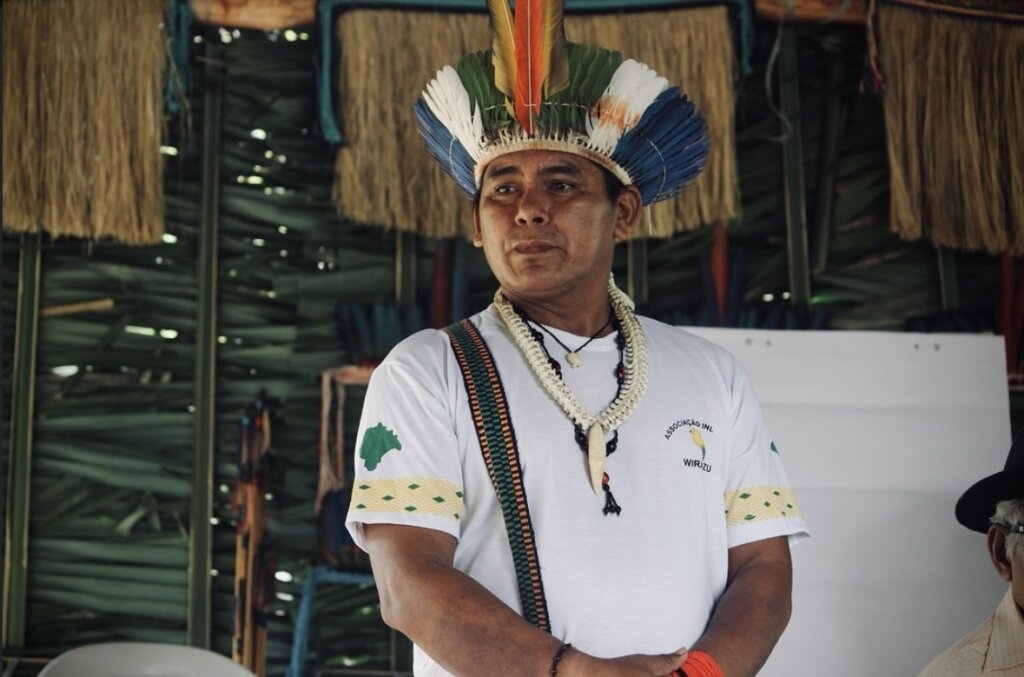
The Institute for Society, Population and Nature (ISPN) expresses concern about the progress of legal proceedings against Chief Antonio Wilson Guajajara, known as Chief Pistola, a leader of the Caru Indigenous Territory in Maranhão.
For decades, Chief Pistola has been active in defending his own and other indigenous territories in the state of Maranhão, protecting the forest and organizing community actions in the face of advancing invasions and illegal exploitation of natural resources. His work has developed within a context of historical absence of the State in protecting indigenous lands, a reality that has led indigenous peoples to organize community actions for monitoring and territorial protection in the region, based on strengthening the indigenous movement and structuring local community groups such as the Guardians of the Forest, the Warriors of the Forest , Indigenous Brigades, youth groups, and respect for the teachings of the elders. The actions and strategies of these collectives have been developed in coordination with public bodies such as Funai, Ibama, ICMBio, the Federal Police, the Public Prosecutor's Office, state secretariats of Maranhão, among others.
His leadership was also essential for the mobilization, creation, strengthening, and official recognition by the Ministry of Environment and Climate Change (MMA) of the Gurupi Mosaic , an initiative that integrates six Indigenous Territories and a Biological Reserve in the states of Maranhão and Pará. This is a significant set of protected areas in Eastern Amazonia, in an area of extreme ecological and cultural importance, whose conservation endures thanks to the struggle, commitment, and coordination of the Indigenous peoples and traditional communities that constitute it. In recognition of his trajectory, the chief became the first Indigenous president of a Mosaic Advisory Council of Protected Areas in Brazil.
It is precisely in this context that it is concerning that serious and generic accusations are being leveled against a leader whose actions are recognized as being dedicated to the collective defense of his people, his territory, and the Amazon.
The defense of indigenous territories cannot be confused with criminal activity. The criminalization of leaders who work to protect their peoples and forests represents an attempt at intimidation and a violation of the constitutional right to free expression, one of the foundations of our democracy. Attempts to intimidate local leaders seek to weaken the protection of territories essential for biodiversity conservation and addressing the climate crisis.
ISPN reaffirms that all judicial proceedings must respect the guarantees of due process, the right to a full defense, and the right to be heard, in addition to properly individualizing conduct, considering the territorial context and the circumstances in which the events occur.
In expressing solidarity with Chief Pistola and the Guajajara people, ISPN also joins the organizations that are warning about the growing criminalization of human rights and environmental defenders in Brazil. Defending indigenous territories is defending the Constitution, socio-biodiversity, and the future of Brazilian forests.