


Traditional Peoples and Communities
The Brazilian semiarid region, with its more open landscape, has become a breeding ground for human settlements, whose livelihoods have allowed them to survive and reproduce even amidst the aridity.¹ Certainly, generations of accumulated knowledge have enabled them to cope with these adverse conditions, such as optimizing water use, managing "pé duro" goats (a native breed resulting from natural selection), making extensive use of flora (food, health, animal feed, etc.), and using native seeds, with species better adapted to regional peculiarities.
The Caatinga people, known as catingueiros, are sertanejos, cowboys, farmers, indigenous peoples, quilombolas, and others. The biome is home to traditional communities, such as the Tumbalala, Xukuru, and Pankararu indigenous peoples, and the quilombolas of Conceição das Crioulas. These human groups have developed their own strategies for survival and coexistence with the Caatinga's conditions. They are guardians of knowledge about plant management, their properties, and medicinal uses, the ancient technique of searching for groundwater with forks (known as hydroesthesia), and the natural signs that precede prolonged droughts and rains.
The Caatinga and its sertanejos became better known throughout Brazil and the world thanks to an iconic story of the sertões: that of the feared bandit Virgulino Ferreira da Silva³, better known as Lampião or the "King of Cangaço." Despite its history marked by conflict and bloodshed, it must be acknowledged that Lampião shaped the image of the sertão. More than 80 years after his death, he remains present in country songs, ornate costumes, cordel literature, theater, film, schools, and museums.
Similar to the sertanejos are those known for their leather clothing (which protects them from the thorny vegetation and the hot sun) and for roaming the backlands on horseback and tending cattle: the vaqueiros⁴. Their greatest challenge is the search for water, which forces them to travel great distances to find a source for the animals. The vaqueiro is so important in the Caatinga landscape that he even has a national day, July 20th, as well as traditional celebrations such as the vaquejadas, a strong popular expression of the Caatinga.
According to the Charter of the Indigenous Peoples of the Cerrado and Caatinga⁵, 45 Indigenous peoples currently live in the Caatinga, with a population of around 90 inhabitants, distributed across 36 Indigenous Lands, occupying an area of almost 140 hectares. Among these, the largest are the Kambiwá and Xukuru Indigenous Lands in Pernambuco, and Pankararé and Brejo do Burgo in Bahia, which together total approximately 107 hectares.
Kambiwá is the largest Indigenous land in the biome, located in the state of Pernambuco, with just over 31,000 hectares.⁶ This people, like many others who inhabit the sertões, were expropriated from their lands since the 17th century to create farms.⁷ Consequently, they sought refuge in the marshes and the Serra Negra region. Currently, they number approximately 3,000 Indigenous people and are undergoing a process of reclaiming their ethnic identity.
The Indigenous people of the Caatinga, as is the case in other biomes, live in small areas and suffer intense pressures that cause serious social, cultural, and environmental impacts. This is a pity, as each Indigenous group has its own unique characteristics, cultural richness, and way of life in harmony with nature. The Caatinga includes the Atikum, Fulni-ô, Jenipapo-Kanindé, Jiripancó, Kariri-Xokó, Kantaruré, Kiriri, Kaimbé, Kambiwá, Kapinawá, Pankararé, Pankararu, Pitaguary, Potiguara, Pipipan, Tingui Botó, Tremembé, Tucumanduba, Truká, Tumbalalá, Tuxá, Xakriabá, Xukuru Kariri, and Xocó, among many other Indigenous peoples, the roots of the Brazilian people.
Although more prevalent in the Cerrado, the Caatinga also has Fundos and Fechos de Pasto communities . Their origin in the biome dates back to the colonial period, when in the São Francisco Valley, with the old corrals of Garcia D'Ávila, in western Bahia, they developed the raising of small animals and subsistence farming, and could hunt, fish and gather other foods, mainly fruits⁸. The way of life of these communities is based on the use of common grazing areas for raising cattle, goats and/or sheep and extracting food and medicinal plants.
There are also people whose trades define them. This is the case of artisanal fishermen, present both in the rivers and reservoirs of the Caatinga, for whom fishing has a much greater meaning, involving bonds of identity, belonging, respect, and knowledge of the spaces they occupy. In Bahia alone, there are at least 130 artisanal fishing communities, located near the state's rivers, mainly the São Francisco and Paraguaçu rivers.
Not exactly a people, but a type of caatinga dweller that deserves highlighting when thinking about the backlands, are those who know how to see the signs and predict the rains, the so-called "Prophets of the backlands," each with their own knowledge, some passed down through generations, or even the result of visions and dreams. It is remarkable that annually, since 1996, there has been the Meeting of Popular Prophets , whose challenge is to predict whether the year will be one of plenty or drought.
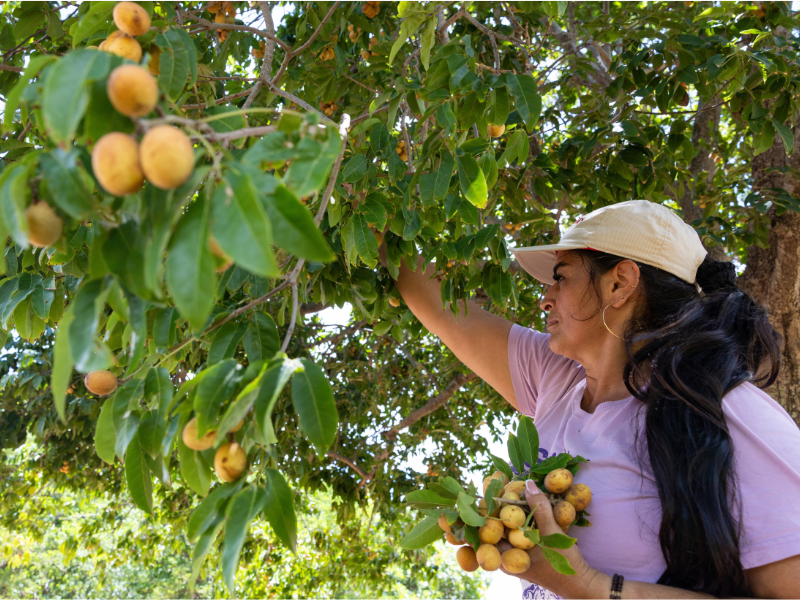
It's also important to highlight the role of women in the Caatinga. Droughts are often reported with images of women carrying large basins or cans on their heads. Certainly, because they are in close contact with water, carrying out productive activities in their backyards and in their daily lives, women play a fundamental role in coexisting with the semiarid region.
Historically, women have experienced (and continue to experience) many inequalities, being subordinated to men in various spheres, whether in their families, at work, or in politics. Little by little, this situation is changing in the Caatinga region, with women uniting in collectives and leading their struggles to guarantee their rights, such as access to water and food in sufficient quantity and quality; access to land; work and income; education; health, and others . These collectives have played a fundamental role in women's self-esteem and in generating work and income through the sustainable use of the Caatinga. There are various cooperatives and women's associations, mothers' clubs, among others, that professionally carry out activities such as: planting productive backyard gardens; processing native fruits; producing handicrafts, cosmetics, and many others. The strengthening of these institutions has fostered even greater protagonism for these warrior women, who are making their voices heard in different decision-making spaces, ensuring better living conditions for their families and communities.
References:
(1) ALBUQUERQUE, Ulysses Paulino de; MELO, Felipe PL. Socioecology of the Caatinga. Cienc. Cult., São Paulo , v. 70, n. 4, p. 40-44, Oct. 2018 . Available at . Accessed on December 31, 2019.
(2) GNADLINGER, João. The search for water in the evening with the indicator rod: an introduction to hydroesthesia. Juazeiro, BA: IRPAA, 2001. 33p. Available at . Accessed on December 31, 2019.
(3) AINSENCHER, Semira Adler. Lampião (Virgulino Ferreira da Silva). Online School Research, Joaquim Nabuco Foundation, Recife. Available at . Accessed on December 31, 2019.
(4) MACHADO, Regina Coeli Vieira. Cowboy of the Brazilian Northeast. Online School Research, Joaquim Nabuco Foundation, Recife. Available at . Accessed on December 31, 2019.
(5) Charter of the Indigenous Peoples of the Cerrado and Caatinga – Challenges for the Environmental and Territorial Management of Indigenous Lands. National Indian Foundation – Funai. October 1, 2018. Available at . Accessed on December 31, 2019.
(6) MMA. Conservation Units and Indigenous Lands of the Caatinga Biome. The Nature Conservancy, Ministry of the Environment. Brasília: 2008. Available at . Accessed on January 18, 2020.
(7) FIALHO, Vânia; BARBOSA, Wallace de Deus. Kambiwá. Indigenous Peoples in Brazil – portal of the Socioenvironmental Institute (ISA). Available at . Accessed on January 18, 2020.
(8) Pasture Fund Articulation presents contributions from communities for the preservation of the Caatinga. IRPAA Coexistence with the Semi-Arid Region. 30. Nov. 2011. Available at . Accessed on January 18, 2020.
(9) RIOS, Kássia Aguiar Norberto Rios. Traditional fishing communities of Bahia: a history of contradictions and resistance. XXIII National Meeting of Agrarian Geography. Federal University of Sergipe. São Cristóvão/SE: Nov. 2006. Available at . Accessed on January 18, 2020.
(10) MARREIRO, Flávia. Signs of Nature – Prophets of the backlands look to the horizon to smell rain. Folha de S. Paulo. 18 Jan. 2004. Available at . Accessed on January 18, 2020.
(11) CONTI, Irio Luiz; SCHROEDER, Edni Oscar. Living with the Brazilian Semi-Arid Region: Autonomy and Social Protagonism. Support Foundation of the Federal University of Rio Grande do Sul – FAURGS, REDEgenteSAN, Sustainable Brazil Environmental Institute – IABS, Spanish Agency for International Development Cooperation – AECID, Ministry of Social Development and Fight against Hunger – MDS / IABS Publishing House, Brasília-DF, Brazil – 2013. Available at . Accessed on December 31, 2019.
- News
- News