

The climate crisis has led governments, multilateral organizations, companies, and philanthropic institutions to mobilize increasing volumes of resources. In 2024, global climate finance flows exceeded US$2 trillion. For 2025, they were estimated at US$2,1 trillion. This value is significant, but still far from the approximately US$7,8 trillion annually that, according to the Climate Policy Initiative, will be needed until 2030 and US$9 trillion annually between 2031 and 2035 to meet global climate finance needs. [1]
The challenge, therefore, is not simply about increasing funding. It is necessary to discuss how these resources circulate, who participates in the decisions, and which organizations are able to access them.
In this context, one question continues to receive less attention than it should: who was already building responses to the climate crisis before it even took center stage on the international agenda?
The answer lies in the territories.
Indigenous peoples, traditional communities, family farmers, social movements, and local organizations have, for generations, developed ways of producing, conserving, and living based on traditional knowledge and knowledge of the territories in which they live. They protect forests, restore springs, manage socio-biodiversity, maintain production systems adapted to local conditions, and build economic alternatives that reconcile conservation and income generation.
This knowledge is not supplementary to climate action. It is an essential part of the responses needed to protect biodiversity, reduce vulnerabilities, and enhance the adaptive capacity of populations and ecosystems.
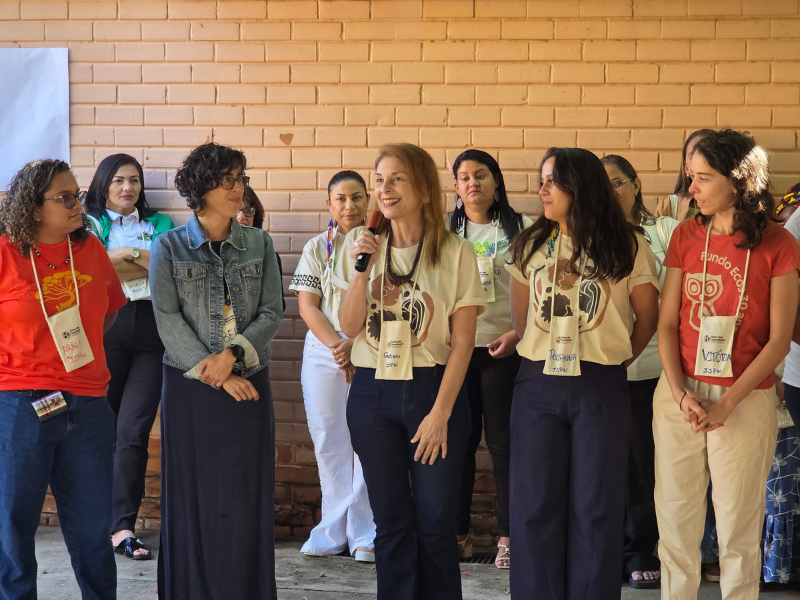
For over three decades, the Institute for Society, Population and Nature (ISPN), through the Ecos Fund, has monitored and supported initiatives of this nature. Since its creation, the Fund has allocated more than US$31 million to over a thousand projects conducted by community-based organizations, especially in the Cerrado, Amazon and Caatinga biomes. [2]
This trajectory shows that the most consistent transformations rarely begin with models conceived from a distance. They arise from the combination of territorial knowledge, social organization, capacity for experimentation, and resources suited to local realities.
This is one of the main lessons learned by the Ecos Fund: being connected to the territories and recognizing existing practices, strengthening the organizations that support them, and creating conditions so that they can improve them, connect them, and expand their results.
The path of resources also matters.
For decades, the prevailing logic in development financing was that resources should travel through long institutional chains before reaching local organizations. At each stage, new procedures and control mechanisms were incorporated to reduce risks and ensure results.
Although these instruments are important, the accumulation of requirements produces a contradiction: the organizations closest to the problems and solutions are often the ones that face the greatest difficulties in accessing funding.
The Organisation for Economic Co-operation and Development (OECD) guidelines on locally led development acknowledge this problem. The organisation states that quality financing should be flexible, predictable and long-term, and should draw on existing local systems and institutions whenever possible.[ 3]
The OECD itself estimates that less than 10% of climate funds are dedicated to locally led development. Although differences in definitions and methodologies still make it difficult to compare these flows, the data highlights the gap between commitments to allocate resources and their practical application. [4]
The experience of the Ecos Fund demonstrates that this gap will not be overcome simply with simpler forms. It is necessary to review how risks, capabilities, and responsibilities are understood and to recognize the leading role of organizations and communities in building solutions.
Trust is not the opposite of good governance. It is one of its prerequisites.
Relationships built over time allow us to understand the contexts in which projects are executed, strengthen organizations, and adjust monitoring, transparency, and accountability mechanisms to different realities.
This does not mean abandoning integrity criteria, controls, or procedures, but rather building mechanisms proportionate to the risks and recognizing capabilities that do not always appear in formal documents. In this context, responsibility ceases to be merely an administrative obligation imposed by the funder and becomes a shared commitment, based on common objectives, dialogue, and clarity about the expected results.
An infrastructure that already exists
Just as solutions to many socio-environmental challenges are already being built within the territories, there is also an infrastructure capable of getting resources to those who develop them. Independent and socio-environmental justice funds, in different countries, connect resources to local organizations and initiatives.
These funds understand local contexts, maintain long-lasting relationships with grassroots organizations, identify initiatives that would be difficult for large funders to reach, and monitor processes that cannot be evaluated solely by short-term results.
In Brazil, the Comuá Network already brings together 20 independent donor funds and organizations that mobilize resources for organizations, movements, and collectives working in the fields of socio-environmental justice, human rights, and community development.
A mapping of community philanthropy in the country gathered data from 31 independent donor organizations. Among the institutions surveyed, 74% supported civil society organizations and 71% allocated resources to movements and collectives, including informal ones. The 14 organizations of the Comuá Network included in the study had directly donated almost R$ 472 million up to 2021.[ 5]
Internationally, the Alianza Socioambiental Fondos del Sur articulates socio-environmental funds from the Global South. Currently, the network brings together 17 funds that, throughout their histories, have supported initiatives in more than 70 countries. According to the Funding from the Ground Up survey , in 2024 alone, its members allocated approximately US$14 million in donations to frontline actors, including grassroots organizations, indigenous peoples, local governance bodies, and community-based enterprises. Its work stems from the recognition that the groups most affected by socio-environmental crises are often also the most excluded from traditional financing models. [ 6]
The participation of ISPN and the Ecos Fund in the Comuá Network and the Alianza Socioambiental Fondos del Sur is part of this broader movement to strengthen independent socio-environmental justice funds and advocate for more accessible, diverse, and territorially-focused financing systems.
These partnerships don't just aim to expand collaboration among their members. They work to transform the relationships between those who mobilize resources, those who define priorities, and those who lead the responses in the territories.
Changing the flows to build possible futures with socio-environmental justice.
Getting more resources to territories through independent funds and socio-environmental justice means not only expanding the reach or efficiency of climate finance. It also means transforming how resources, decisions, and power circulate.
When organizations close to the territories participate in defining priorities and have flexible resources to support locally built solutions, communities, indigenous peoples, and grassroots organizations cease to occupy only the role of executors of externally defined agendas. They expand their capacity to decide, propose, and sustain their own responses to socio-environmental challenges.
Given the scale of the climate crisis, mobilizing more resources is essential. But the necessary transformation also depends on who participates in the decisions, where those decisions are made, and how much knowledge, institutional capacity, and autonomy remain within the territories.
Democratizing climate finance, in this sense, means expanding who can imagine, propose, and participate in decisions. Bringing resources and decision-making power closer to those who live in, know, and care for the territories contributes to building fairer responses, strengthening democracy, and transforming into reality what often still seems impossible.
References
[1] Climate Policy Initiative. Global Landscape of Climate Finance 2026 and data dashboard on global flows of climate finance. https://www.climatepolicyinitiative.org/resources/data-visualizations/global-landscape-of-climate-finance-data-dashboard/
[2] Total value in US$ adjusted to 2025.
[3] OECD. Practical Guidelines for Supporting Locally Led Development: Quality Financing to Local Actors . https://www.oecd.org/en/publications/practical-guidelines-for-supporting-locally-led-development_eaecf72b-en/full-report/action-area-quality-financing-to-local-actors_70bc9dc7.html
[4] OECD. Practical Guidelines for Supporting Locally Led Development: Clarity of Intentions and Definitions.
https://www.oecd.org/en/publications/practical-guidelines-for-supporting-locally-led-development_eaecf72b-en/full-report/action-area-clarity-of-intentions-and-definitions_306ac241.html
[5] Comuá Network. FCommunity-based ilanthropy in Brazil: principles, practices, and priorities..
https://redecomua.org.br/wp-content/uploads/2025/02/Filantropia-comunitaria-no-Brasil-Sumario-PT.pdf
[6] Alianza Socioambiental Fondos del Sur. Funding from the Ground Up: A Global Study of Locally Rooted Socio-Environmental Funds . 2025. https://alianzafondosdelsur.org/wp-content/uploads/2025/10/Alianza_Funding_from_the_ground_up.pdf